
Wild survivors
and the invisible work of a revolution

Ten years ago, a family on their way to the cinema (or the beach, or even the woods) on a rainy Sunday, opens the car windows to lob their apple cores out. As mum explains, it's okay to throw these out. The fruit will rot down into the ground. The worms will love it. The eldest kid, 12, stretches out wide to get his as far into the roadside bramble as possible. Except for the youngest, 6, the disposal is forgotten within minutes. He sits with it a while longer distracted by visions of giant earthworms surfacing to gobble the apple whole.
Apples are one of the few things that a British person can feel proud of. Before our ancestors exported empire, slavery, and free market capitalism, they bred and shared thousands of varieties of this delicate fruit. They serve as a reminder of the radical historian EP Thompson’s speech at Glastonbury in the 80s, that “this has not only been a nation of money-makers and imperialists, it has been a nation of inventors, of writers of activists, artists, theatres and musicians.”
The state of the apple today leaves little comfort in Thompson’s ‘alternative nation’. In the last hundred years, we have lost 81% of the traditional orchards. My home county Cambridgeshire used to be full of them, but in the 70s the government paid growers to dig up their trees for arable farming. Of the 3,000 known varieties of apples bred on this island, only 4 kinds (bred elsewhere) make up almost all of the half million tonnes of apples we eat a year. This shrinking of diversity is leaving food growers vulnerable to both ‘genetic erosion’ (the loss of genetic diversity) and a volatile climate. The relentless drive of homogenisation (everything being made the same) has left us exposed.
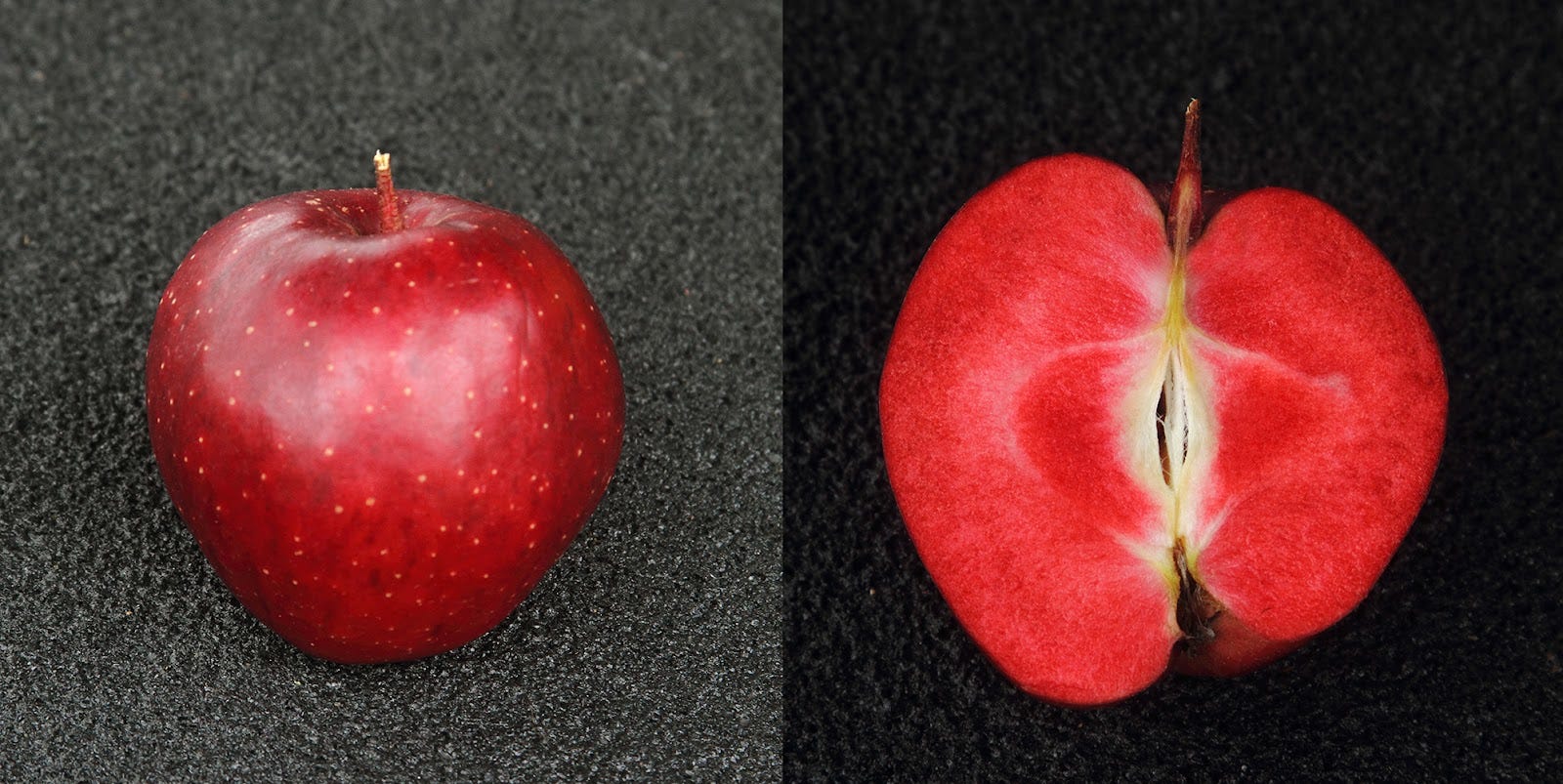
Now, back to our family, who, all these years later, return to the cinema (or ice skate rink, or shopping centre). They drive the same route and, without noticing, pass a chaotic row of maturing trees on the verge. This is the first year these trees have blossomed. They are covered in pale pink flowers. Each one has been visited by a honeybee, a hoverfly or a wasp. And each will produce a raft of wonky, inedible fruits. This would be the expected place of a goldilocks rendition: the dad’s apple too bitter, the mum’s too sweet etc. But happily, the real world is weirder than that.
The fruits of these incidental trees are apples that have never been seen before. One is tart enough to turn your face inside out, with chalky white flesh; another is enormous, mushy and tasteless; another is small, soft, delicately bitter, and so on. This happens because apples, more than most other plants, shuffle their vast genome vigorously each time they reproduce. Botanists call it heterozygosity. It means that, like humans, you can never predict what the progeny will become. What you lose is consistency and stability between parents and child, but what you gain is extraordinary genetic creativity. This gives them more chance for adaptations and, in this climactically unpredictable moment, a higher probability of survival.
Reproductive chaos of this kind is the industrial fruit producers nightmare. Apples wouldn’t be worth the effort if whenever you wanted to grow a new tree, you had to place your fate in such randomness. This is why, instead of growing fruit from seed, people clone trees. By taking a cutting, grafting it onto a set of roots, you can be sure that you’ll get exactly the same variety in a few years time. This works for us. It controls the world.
But the industrialist’s nightmare is a creative breeder’s dream. Small breeders like Ystwyth Valley Apple Breeders - who are some of the only people thinking about what traits trees will need to weather the climactic storm- depend on the randomness of the rogue apple’s genome. They call them the ‘wild-survivors’; the unassuming trees, barely noticed growing on roadsides, by train tracks and in the forgotten corners of the country. To these breeders a discarded apple core might go on to become the source of a priceless creative power. One that will become more and more valuable as transformation becomes more and more urgent.
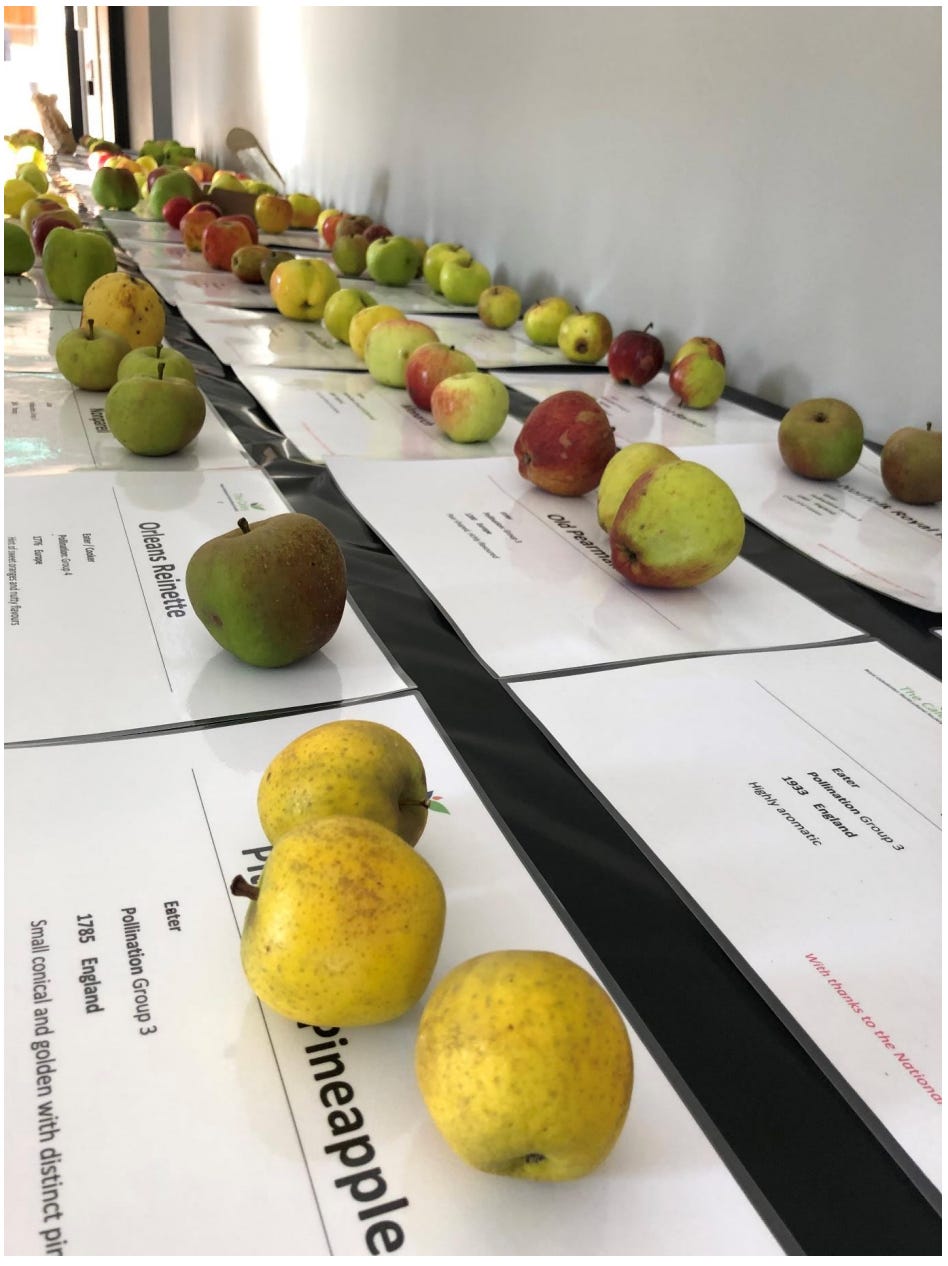
This esoteric world of apple breeding matters because it perfectly corresponds to so many of the other big social questions we face. The crisis for food growers is entangled with the crisis of contemporary capitalism. The relentless homogenisation of everything has eroded, coopted and degraded our shared pool of creativity. But, as in the rest of our ecosystems, zones of play, deviation and weirdness still exist. And now is when we need them most.
All large-scale social transformations involve sudden outbursts of creativity. It happens quick and looks spontaneous, though it is anything but. In David Graeber’s account of the Malagasy revolution in Madagascar, the people turned on an entrenched monarchy, alongside all other forms of oppression and domination, with incredible speed. As David observes, much of the work of making this revolution occurred in the quiet, marginal cultural zones. He called it the “spectral nightworld” and described it as “a kind of creative reservoir of potential revolutionary change.”
Which begs the question. Do we have any of our own zones left to speak of? And if we do, how do they survive? And what can we do to nurture them?
These are open questions, not for me (or anyone) to answer definitively. But from my limited vantage point our wild areas live and not by accident: whether it’s squatted buildings quietly turned into outrageous night-long carnivals; the FINT (female, nonbinary, intersex, trans) led camp protecting our pagan heritage from the forces of ‘progress’; the cooperative cafe down the road feeding everyone who needs it; the asylum seekers, who have been caged into a hotel, organising themselves a food cooperative; or smaller signals, like the impromptu speech the young woman from the estate gave at karaoke the other night, insisting that no matter how much worse things get, we’ll all get through this crisis because we have each other.
David could have been talking about these when he said, “it’s precisely from these invisible spaces—invisible, most of all, to power—whence the potential for insurrection, and the extraordinary social creativity that seems to emerge out of nowhere in revolutionary moments, actually comes.” These wild orchards -and many more seeds besides- make up the invisible, often uncelebrated labour of a revolution. This is the source of the essential creativity that these worsening storms will demand of us.
The pairing of the status of apples and of a protorevolutionary counterculture isn’t just a useful illustrative tool or a cutesy coincidence. Nor is it just another example of the bottomless ‘look what we can learn from nature’ genre. It’s a reminder of the weird, inextricable ways our social lives are more than our human-social lives. The structure of our relationships with the entanglement (a better word for the ‘environment’) shape and are shaped by the relationships of society. Or in other words, life wants life to defend itself.