
Deep Time Thinking and the Rojava Revolution
There’s a lot to learn from one of our time’s most successful revolutionary movements.

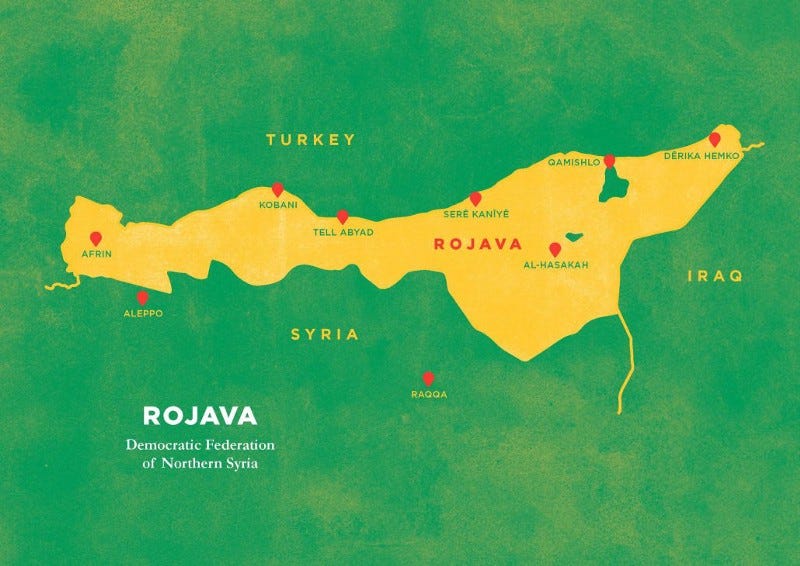
There’s a lot to learn from one of our time’s most successful revolutionary movements. Since 2011, the Kurdistan Freedom Movement in Northern Syria has built a radical democracy (sometimes referred to as Rojava) that puts ours to shame. The region’s inhabitants of over 2 million people have organised into hundreds of communities along feminist, ecological and egalitarian principles. What I think’s worth paying attention to is their attitude towards time.
These revolutionaries see themselves participating in a drama that has been underway for at least 10,000 years, and one that certainly won’t be concluded in their lifetimes. The pivotal moment in human history in the middle east was the shift into what is called the ‘Neolithic’ period, where we moved from matrilineal, animistic and cooperative cultures to male-dominated, hierarchical and exploitative ones. Abdullah Öcalan is one of the movement’s chief theorists and is widely hailed as the Nelson Mandela of the Middle East, because of his confinement in a Turkish prison-island for the last 20 years. He describes this age-old conflict as existing today between “democratic civilisation” and “capitalist modernity”.
The journalist Frederike Geerdinke spent a year embedded with the revolutionary movement documenting the attitudes and workings of the radicals into the book that became This Fire Never Dies: One Year with the PKK, published last year. Every time she asks anyone about the group’s ideology, she observes, they answer first by saying, “See, in the Neolithic Age…”. This deep view of history isn’t just a superficial story, it permeates the movement.
And she finds that this long view backwards facilitates a long view forwards too. I was struck by this interaction she has with Comrade Botan, a Kurdish revolutionary, in a base in Kirkuk, north-west Syria:
“But do you really believe we will ever live in a world without nation-states or capitalism?” she asks.
“No, I don’t believe it, I know it” he answers. “And do you know how I know? Because the current system is not sustainable. The essence of humanity is incompatible with capitalism and the nation-state. Like any other living organism, a society is subject to evolution. If it doesn’t adapt optimally to its surroundings, it doesn’t survive.” Sooner or later, he goes on to say, “it will collapse, that much is certain”.
“Do you think it will happen in our lifetime” Geerdinke asks.
“Not in my lifetime, or in yours,” he says. “But the foundations of what comes after it, that’s what we should be working on now”.
It’s a burning question: in the middle of a civil war, after decades of repression, how has this movement managed to transform this part of the middle east from autocracy into a radical ecological democracy? There are many factors, but this depth of commitment has something to do with it.
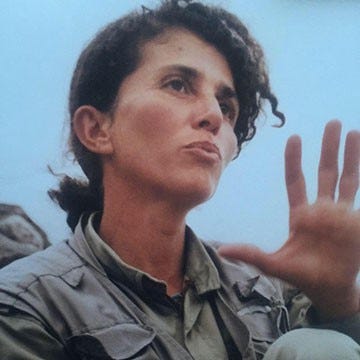
And you can see it in the origins of the movement. Sakine Cansiz, one of the early founders of the movement, assassinated in Paris in 2013, wrote about it in her memoirs. The movement emerged from the tireless, committed organising of what were at first a handful of radical women, organising meetings from house to house, and raising the level of political consciousness one person at a time. To sustain this, while facing the constant repression of the Turkish state, was only possible with a deep understanding of their small role in an enormous, long unfolding of events.
As well as a commitment to overcoming repression, there are other ways that this deep understanding of time solidifies the movement. I recently read some notes (hopefully soon to be published as a book) from a friend from the UK who spent a year in the movement in Northern Syria. There are many brilliant moments, but one surprising one has stuck with me. It described something immensely common among organisers: an interpersonal conflict was escalating. Frustration, resentment and even betrayal were brewing. The person at the heart of it, a British volunteer, described how if anything close to that happened in the UK, the group would have already fallen apart; leaving everyone bitter and resentful. But in Northern Syria that was off the table. The commitment to the movement meant staying with the conflict and confronting deep, difficult aspects of themselves. There are many reasons for this level of commitment and willingness to endure the tough moments; I think the long view of the movement and the deep sense of place and purpose it gives the activists is a big part of it.
Back in ‘the west’ it’s a cliche to say that many of the problems we face today can be traced back to a narrow view of time. There are a raft of books written about it (see Roman Krznaric’s The Good Ancestor and Marca Bjoernerud’s Timefulness: How Thinking Like a Geologist Can Help Save the World as two good ones). The arguments are familiar and sensible: politicians make bad decisions based on election cycles of a few years; news cycles focus on only the most immediate and shocking issues; and the pressures of an exploitative economy keep us planning only the next few days, months or, if we’re lucky, a few years. ‘Time denial’, ‘short-termism’, or even ‘temporal warfare’; whatever it’s called, it runs deep.
Some theorists trace it back to the invention of the mechanical clock in the 1300s, some to the industrial revolution’s regimentation of the workforce with the clock in the 1800s; it’s also important to note how in just the last half of the 20th century, the financialisation of the economy has freed capital to move around the world in milliseconds and encouraged a culture of hostile takeovers asset-stripping companies for the short term gains of shareholders.
Alongside this analysis, there are plenty of proposals for addressing it. For a really fun and thorough exploration of a lot of the recent work on ‘Deep Time Thinking’ have a listen to the Long Time Academy’s new podcast series. Ella Saltmarshe, the host, gets some excellent writers and organisers on and beautifully weaves many ways of thinking through time.
The proposals tend to revolve around developing (or redeveloping) practices to engage with our position in a very long story. One suggestion is simply that we spend more time asking, “What might our descendants wish we had done better for them?”. Or undertake the Deep Time Walk with the app, where we can literally experience with our bodies the sheer scale of this planet’s existence. We might do a simple thing, like adding a 0 or two to the year when we write it, making it 02022. Or we might take inspiration from the many indigenous cultures that explicitly consider the effect of our actions now on seven generations in the future.
All of these things can be profound, and help to connect with the reality of our impact now and in the future. But I have a nagging sense that they won’t cut it by themselves. It’s pretty astonishing to find how many theorists of ‘Deep Time’, after compiling incredibly thorough research on the topic, seem only able to stretch as far as ‘we all learn more about this’, as a serious collective solution.
I can’t help contrasting that prognosis with the work of the revolutionary Kurds. The difference is the Kurds and the other ethnic groups involved in that revolutionary society, have spent decades organising to deepen the sense of time and place among the people. It wasn’t something that was just going to happen. And it could just as easily not have happened.
But there is a lot here to work with. And the intuition that the dominance of the shrunken view of time is fucking things in a big way is right. But I think a really powerful synthesis is still waiting to happen in our context. There is the need to ritualise extending our temporal imaginaries, there is the regular individual practice of shifting our awareness, and then there is the telling, retelling and telling again of a new story of ancient belonging.
This story won’t be a fixed, canonised text that we need to rehearse, but a living focused inquiry into the long historical causes of our current ruinous culture, the equally long resistance to it, our role in determining the next few pages, and, dare I say it, postponing the abrupt, unsatisfying and senseless end in store.
(Dog Section Press have produced a few excellent books on the Rojava revolution, to receive a copy of their new one support their crowdfunder, live for only 3 more days here).