
Belonging to a better nation
Anti-racism, the land and englishness

I felt disgust. I felt a mild fear. I felt fascination. I’d travelled the distance from where I live to the centre of London, but in the opposite direction, and I was in Epping, a foreign country. I passed the Bell Hotel, temporary shelter for 150 people seeking safety, dressed with heras fencing and stalked by police vans. And I passed dozens of St. George’s cross flags and Union Jacks hung on every possible vertical surface, as if I was entering palace grounds on coronation day. But Epping is no palace, and these flags weren’t doing a nostalgic pageant, they were doing what flags do worst, marking territory, signifying insiders and outsiders and building one community on the back of another.
And yet, despite all the ugly nationalism creeping into Epping, and while watching Israel’s theological nationalism and racial supremacy starve children in Gaza, I have the Scottish nationalist Alasdair Gray’s creed in my head this week: “Work as if you live in the early days of a better nation.”
The line stirs something sincere in me. A longing to belong to something good. A desire which, before it is crushed up, cut with poison and injected back into us, comes from the land. The silver birch, the sparrows, the nighttime smell of air over fields at dusk, all raise some serious questions: What is this place? Why do I love it? And, why do some people find it easier to than others?
Once upon a time we may have been able to answer these questions honestly and openly, drawing on a collective wisdom and a shared memory. Today this feels hard. But it’s not impossible. Owing in part to her blackness on an island that, consciously or not, considers itself white, Clare Ratinon, in Unearthed: On Race and Roots, and How the Soil Taught Me I Belong, outlines an answer.
For her, belonging to the land, and healing from a deep grief, was prompted -as it is for many of us- by growing vegetables in a community garden. From mulching soil, learning the language of bees and marvelling at how ecosystems work up close, Ratinon started a journey of revived intimacy with place and life. This intimacy drew her into questions about her Mauritian ancestors. What would their relationships to the land have been like? Why was so little of this knowledge passed down to her? And forced harder questions about the hostility of the alternative food movement to the colour of her skin. Why are there barely any other black people in the garden? Why is there no acknowledgement of horticulture’s deep, historic connection with colonialism?
Hers isn’t an outlier experience for BPOC in this movement. Farming, conservation and working outdoors are the least ethnically diverse industries in the country. A report a few years ago documents the widespread experience of BPOC growers consistently feel isolated, being perceived as less competent, being tokenized, and being sick and tired of their white colleagues not being comfortable reflecting on how the past shapes the present. To the non food growers amongst you this might seem a bit niche. But my sense is that this problem in the world of food growing has a lot to say about land, identity and belonging. So bear with.

There are at least three ways to read Ratinon’s story as a white person. As the Epping flag lovers would, you could call her woke and oversensitive, and disregard her story. Or you could feel bad for her, mildly guilty, and want to help. Your other option is to take it as a signal that something important is missing and hear it as an invitation to rebuild our collective memory.
We find ourselves in the same situation as the characters in Kazuo Ishiguro’s 2015 novel, The Buried Giant. In the story, a strange mist has made everyone in an early England forget themselves. An elderly couple can barely remember their son. A village forgets the target of their outrage. Suspicion and confusion reign.
What people don’t know is that, after a particularly violent war, the mist was intentionally manufactured to break the cycle of conflict between the Saxons and the Britons. What’s clear in the novel is that the costs of forgetting are higher than the risk of remembering: “blandness emerges as a traumatized truce, a colorless pact that holds the personal and historical present together at the cost of a sinful amnesia” (Ishiguro).
For food growers, to recall the colonisation of this island alongside a quarter of the rest of the world’s land mass, to realise the deeply troubling expansionist urge in the psyche of the British elite, and to remember the empire’s protectorates, administrations and plantations were all predicated on industrial agriculture, helps enormously to clarify who we want and don’t want to be.
At the same time, while empires have been built and maintained with the control of land and food, resistance to empires has also been built on reclaiming land and food. From Gerard Winstanley’s occupation of a hill in Surrey in the 17th century, to the reclamation of Haiti by formerly enslaved people in the 18th century, to Cuba’s continued survival through agroecology today, as Ratinon says, our “incomplete, erased and untold” past doesn’t just risk us following the same idiot leaders again, but amounts to “a robbery of history and hope, of culture and tradition, of imagination and dreaming up futures on our own terms”.1
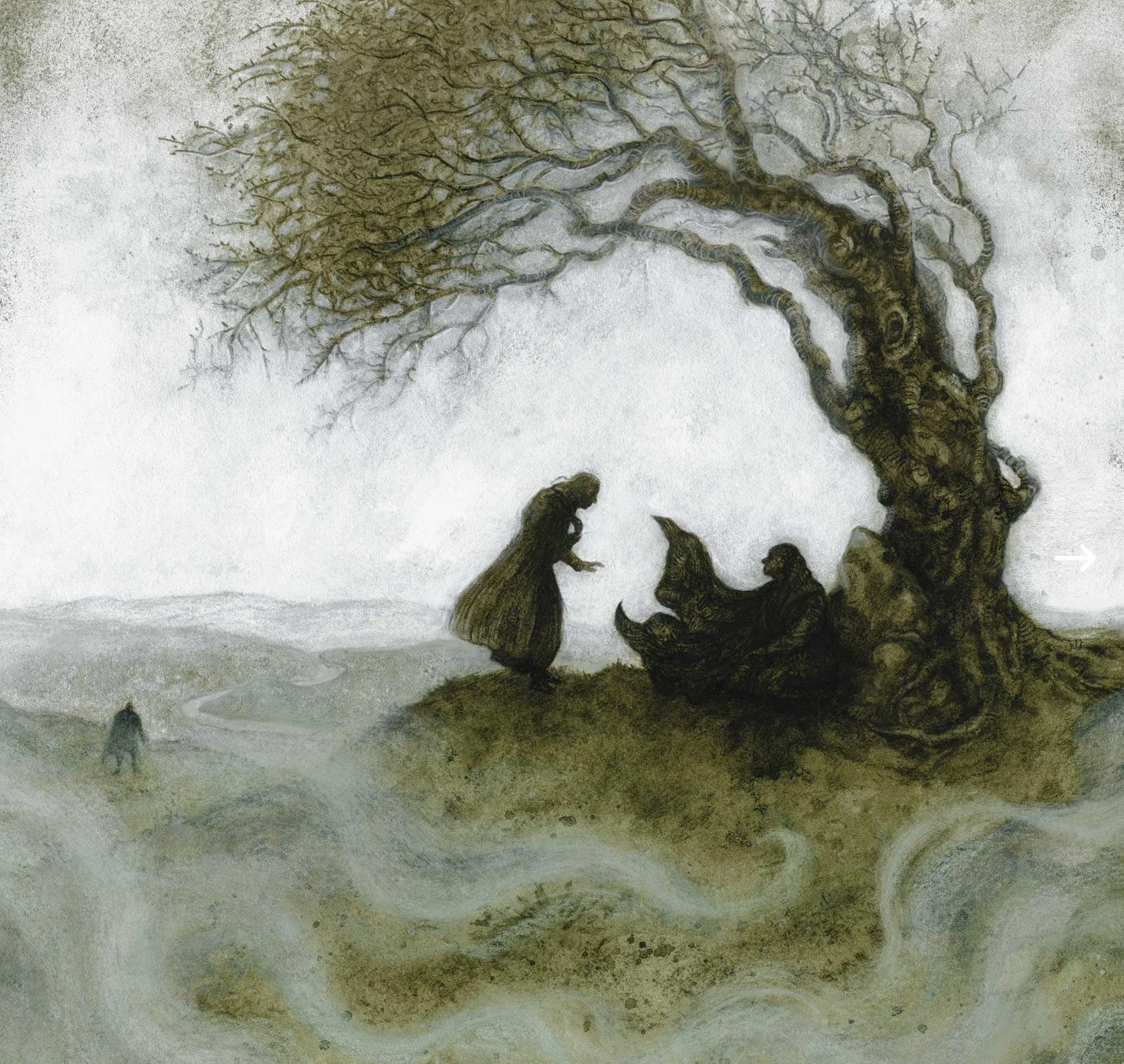
To be crystal clear, this white amnesia hasn’t happened through lack of care and attention on behalf of everyday people. It’s an organised forgetting, and it has been imposed on us. Later in Ishiguro’s story, we discover that it was King Arthur and Merlin who manufactured the mist to maintain order in their new England. This is how Englishness works. And it’s funny because the Arthurian legends themselves were reinvented by the Victorian elite, along with St. George in the early 18th century to bind English people into the cause of pillaging the world. Meanwhile today, stories of Churchillian wartime heroics comfort the children (our future elite) abandoned by their parents at Eton, who in turn, in their own adulthood, use the very same stories to placate their own children (us) whom they also otherwise shamelessly abandon.2 As it was, so it is: Englishness is a spell to enshrine an artificial hierarchy. And, wherever there is the need to reimpose order, it is recast. This is the other significance of the flags popping up around the country: a new hierarchy is waiting to be born.
This is also why guilt is rarely an appropriate response, and why a defensive rejection to “wokery” is so common. It is not fun to realise you have been duped. But as James Baldwin observed, “people who shut their eyes to reality simply invite their own destruction, and anyone who insists on remaining in a state of innocence long after that innocence is dead turns himself into a monster.” In short, it’s time for white English people to refuse the adolescence imposed on them, it’s time for us to grow up.
That could happen in a garden. Anti-racism in our small corner of however a loose, baggy tapestry of rebellion emerging in these isles could be an invitation to remember. It could be a demistification. A joyful recall. Possibly there’s a connection between land work being most afflicted by racism and exclusion and its unique potential to weave an anticolonial culture (into the culture as a whole, but especially) amongst white people, who might finally come good on the ask to see how our liberation is “bound up” with the liberation of everyone.3
Not that it’ll be easy. Reclaiming memory is the same process of weaning ourselves off of seductive and stultifying systems as reclaiming the food system. Nationalism is the McDonald's of belonging: cheap, addictive and built on cruelty. It’s everywhere, one, because powerful people have crushed the alternatives, and two, because it is a quick comfort in a hard life. Building the alternative in these conditions is tough. But there is power in the fact that the hunger is deep. The body (politic or otherwise) deep down knows when it’s being poisoned.
And as well as forging a more durable belonging and escaping the monstrous consequences of a history repressed, telling the true story of this land and its people directs us towards strategic interventions that might just build the better nation we dream of.
To know about the Irish potato famine, or the series of empire-induced famines across India, teaches us that food has consistently been a tool of control. To learn about how the economy of sugar as a means to fuel a new industrial working class in Britain was dependent on enslaving Africans in the Caribbean; to know about how indigenous land the world over has been subtly and not so subtly stolen to grow soy, and to make land workers dependent on global commodity markets; to know all of this sheds a different light on stories of child slavery in cocoa, corporate theft of seeds and the scale of farmer suicide around the world.4 None of these are surprising accidents. “Where is imperialism? Look at your plates when you eat.” (Thomas Sankara).
To develop a sense of this (to understand it entirely is overwhelming and impossible) changes the aims and strategic choices of a renewal of local, community agriculture here. Our work becomes simultaneously a tool to improve our lives, to wean ourselves off of this global system, and to support others to transform it. It leads to solidaristic partnerships like Hodmedods selling Pi’Y Brazil Nuts direct from the Kayapó in Brazil to support them in protecting 40,000 square miles of Amazon rainforest. Or the LWA Soy No More! campaign finding agroecological alternatives to the soy-based animal feed destroying the rainforest, poisoning rivers and producing more than half of the UK’s total emissions. Or a twinning of UK agroecological farms with Palestinian farms in the West Bank to share knowledge and resources.
Imagine a deeply outward-oriented community food revolution on these lands, where learning exchanges are commonplace, where seed cooperatives span the world, where community wealth building includes our global community of peasant comrades (brazil nuts in every free school breakfast!), where gardens fight and temper our hostile border regimes by providing sanctuary and meaningful work, where we synchronise our sabotage of multinational agrochemical companies, for example.
This is what a “better nation” could mean. A multispecies civilisation based on reciprocity, autonomy, curiosity, pluralism, humility, abundance, and yes-cheesy me-love. But while we heed Alasdair Gray’s call, we must also work as if we live in the early days of a worse nation, because, at least for the next decade, we do. Farage and his ilk have the upper hand, and they will quite happily repeat the tradition of the English elite of twisting our wholesome, authentic and meaningful relationships with the land into a fear-filled, hateful ideology. We can’t make their job easier by ignoring the need to build an alternative, enduring belonging.
1. The Offshoot newsletter is a great source of stories for this.
2. Richard Beard’s account of the child abuse of boys at Eton explains a lot.
3. As the Aboriginal rights movement in Australia (often attributed to Lila Watson) says: ”If you have come here to help me, you are wasting your time. But if you have come because your liberation is bound up with mine, then let us work together.”
4. The Sankofa Report written by Jada Phillips summarises this well.
Really enjoyed this. Made me want to learn more about the Cuban agricultural system. I have often thought of food security as important to build resilience in the face of food system collapse but very interesting to think of it as a means to develop and maintain economic and political sovereignty against colonialism.
Love it! you're such a coooolll writerrr