
Are rivers alive?

Things are not going well between humans and rivers on this archipelago of Western Europe. We have covered and dammed 97% of them. We have allowed water CEOs to pump hundreds of gallons of sewage into them, with little to no protest. In London alone, 21 rivers spanning 444km have been buried beneath concrete.
And if you’re looking for some old mythology to help revive and restore our relationship to the flow of water through our land, you’ll struggle. The last few hundred years of folklore about rivers do not promise reconciliation. Across the country, from the Knucker Dragon in Sussex or the Lambton Worm of the river Weir, the Afanc in Llyn Barfog, Wales or the Kelpies of Scotland, river spirits devour livestock and occasionally humans. In all of these stories, it takes a strong man to defeat and tame them, hardly a useful bit of ethical direction for us.
This disconnection between those of us born 75% water and those of us born 100% water is historically unusual. Humans have always needed rivers because where there are rivers, there is life.
If you plotted on a map the world’s preindustrial biomass, it would be as if you’d taken a thick felt-tip pen to all of the earth’s waterways. Rivers make life: plants, fish, birds and mammals explode in numbers around them. Because evolution speeds up in places with higher biological density, we should think of rivers as the creative hearts of our earth.
This creativity has always attracted settlers. For the last 10,000 years or so of semi and permanently settled civilisation, everything has depended on rivers. ‘Flood recession agriculture’, where fields are farmed in dry seasons and fertilised by annual flooding, was (and still is) by far the most energy-efficient form of plant cultivation, and, prior to the steam engine, rivers carried almost all of our stuff (it being quicker to sail from London to South Africa than to travel overland to Scotland).
This intimacy has made us who we are. It has shaped how we think. Time, conversation, blood, people - even a good story - all flow like a river. As Ivan Illich says, “water has a nearly unlimited ability to carry metaphors”. Think of the wet origins of being stuck, rushed, flooded, released, overwhelmed, or writing a stream of consciousness. This last one makes me think there might be truth in the claim some people make that rivers are an “orientational metaphor”, structuring how all other metaphors relate to one another, helping us think about how we think.*
It cannot be great news then, when the real-life source of an orientational metaphor gets blocked, poisoned, ruined, etc.
Some folklorists say that all we need to do is revive older stories for all of this to change. I’m not convinced.
We are at the end stage of an almost universal trajectory for the human-river relationship during ‘modernisation’. When our rivers were clean and nourishing, we worshipped river gods. Rock art in Africa, Australia and the Americas shows water serpents as far back as 30,000 years. Water snakes, serpents and dragons feature in Aztec, Maori, Chinese and Egyptian depictions as well, to name just a few. Water spirits have almost always been, what Strang describes as, “quintessential symbols of the non-human domain’s generative capacities.” But since draining and damming them, rivers became unpredictably violent, and we began to fear them. And, over the last 250 years or so, as we straightened and concreted over them, most have forgotten the river gods entirely.**
The unruly and threatening river spirits of our folklore suggest that the majority of ‘native’ mythology from these isles draws mostly from that middle period. There are a few exceptions, such as the story of tiddy mun, a water spirit from my homeland of the Fens in East Anglia who began as a generous and protective water spirit but who transformed into something cruel and unforgiving during the drainage era. But even with this story, recorded from a single oral testimony from the late 19th century, where do we take it?
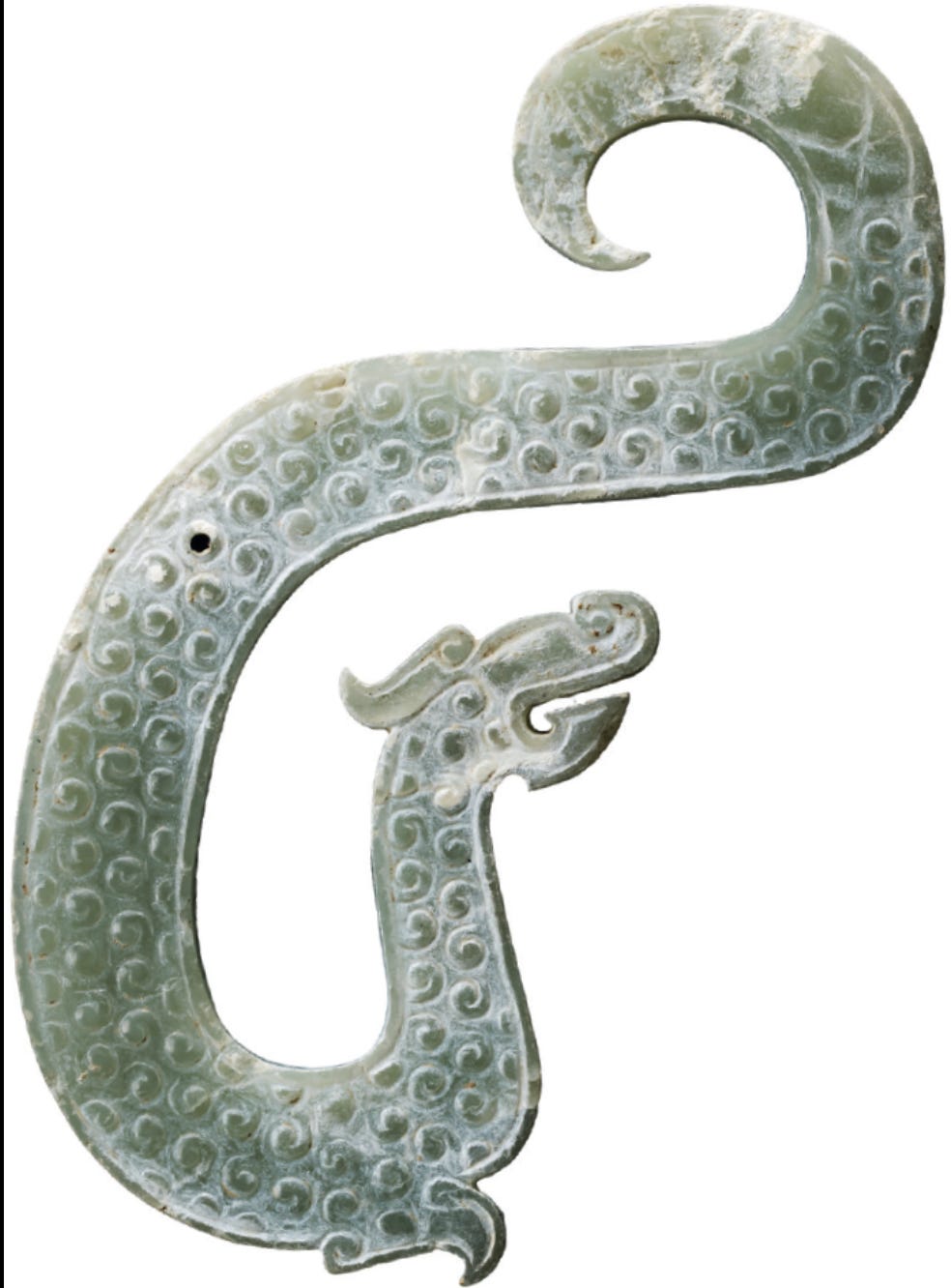
Another solution to our predicament could be found in Strang’s pretty rad claim that rivers have always participated in telling their own stories. This, she says, is the only explanation for the incredible consistency of water related mythology around the world and throughout time: “Water’s core meanings as a life-generating, life-connecting source; as the basis of wealth, health and power; as a transformative medium; and as a metaphorical base for concepts of movement and flow, recur so reliably in different cultural and historical contexts that there is little choice but to conclude that its material properties are relationally formative.”
If this is true then all we need to do is restore rivers and improve people’s access and let the immanent phenomena of moving water do the rest. I like it, but is it enough? I have walked alone for days along rivers, camped by rivers, let the endless unholy thrashing of water over rock fill my dreams of rivers; and had momentous experiences with rivers (climbing a waterfall at the peak of a psilocybin trip to emerge into adulthood at the crest), but I have never thought of a river as alive.
Reading the last chapter of Robert Macfarlane’s new book persuades me that to start to genuinely rediscover rivers as alive, it helps to get some guidance from people who never stopped thinking this.
In 2023, Macfarlane’s life was changed by a river. McFarlane, darling of British nature-writing, erstwhile tramper of old lanes, philosopher of walking, memory and belonging, and, to some, slightly too much of the solo heroic nature boy, decided to spend 10 days living with a river, and something unbelievable happened to him.
Kayaking for 120 miles down the Mutehekau Shipu River in Canada, he was as close to a river as you can get. Reading his adventure progressing, you begin to notice the river seeping into him.
If you looked at a river from above and sped up time, it would look like a snake writhing forward in a landscape. Any slight curve in the path of water begins to reinforce itself as silt is banked on the inside line, slowing the water and causing more silt to be deposited. The forward force of water causes these curves to gradually shift downwards. But occasionally, a river will jump from its course. It will cut a corner and create a new crescent-shaped lake out of its old path, or it will change direction entirely. This dramatic shapeshift happens when rivers flood, and it often utterly transforms a landscape.
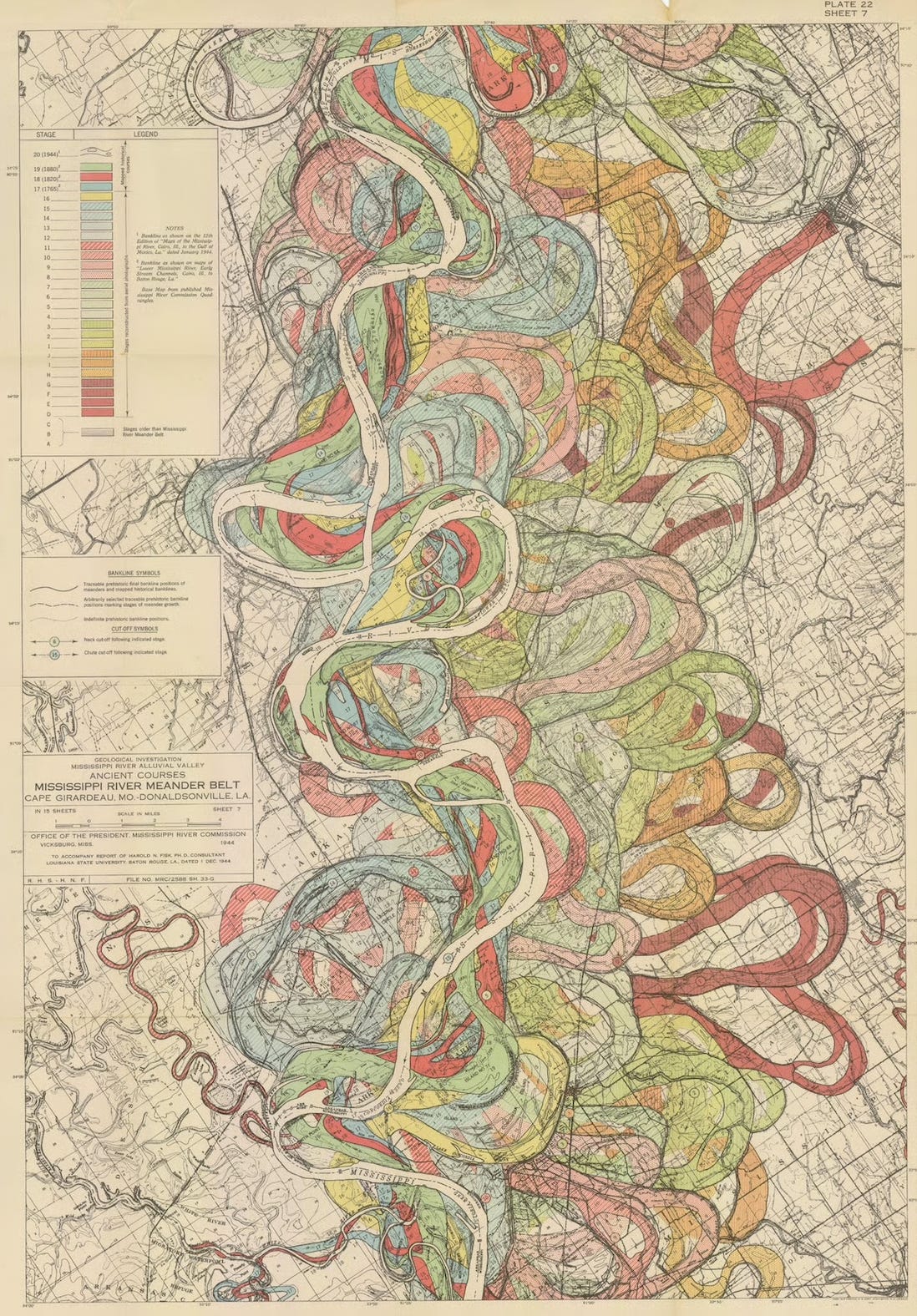
Like a river’s own change, McFarlane’s transformation happens slowly before -in a flood pulse- it happens all at once. Standing on a rock, transfixed by the endless fall of water in on itself at the end of his journey, he suddenly grasps the true nature of the river, skipping back a few centuries to see what millennia of people seem to have seen in the river god.
Had he been doing this all alone, I don’t think this would have happened. His guides were essential, and none more than Rita Mestokosho, an Innu poet, direct actionist and elder. Before he set off, Mestokosho advised him to follow a number of rituals. He must set up his tent to face east. He must take a piece of red thread and tie it to the sacred tree when he finds it. He must fast for more than 24 hours. He will, she says, have one question which the river will answer. Finally, she says,
“I sense that you are afraid, Robert. Because in your manner of seeing things, you put people here, and rivers over here. You think in hierarchies. This is not a criticism – it’s a fact. Instead, you need to seek the current, the flow.”
For those of you who won’t read the book, this is an abridged version of what happened:
“At our feet the river smashes ceaselessly into a super-massive white hole of its own making, churning and quaking, and I feel queasy and drawn and obsessed. (...) Spray from the Gorge drifts upon us, dewing our clothes and wetting our eyes, and tiny rainbows roam rainbows roam like iridescent insects, and we talk as best we can amid the uproar and we realize that our speech is speeding up under momentum not our own, is becoming rapid with answers and thoughts tumbling across and into one another, and later both of us will describe the shared sense that somewhere on that almost planet-old rock we stepped across an invisible border and into a zone where the usual locks and screens were not in place.
(...) a few inches from destruction, where water, rock and air are all three glossy, and I glance up and understand that I am looking into a mouth, an immense river-maw that pours between the jaws of the Gorge, and I see that this mouth has a tongue, a vast green-white tongue which tapers and glides to its tip right at my feet, and I hear speech is tumbling out of this mouth, has been tumbling out of it since the old ice left, and that this is a place where ghost-realms of times past and future overlap with one another, each transparent to the other (...) and in that moment it is clear to me that this is the aura of the river-being –
why should a god make choices we recognize as choices?
– and the coast of my mind senses this force and I know, know, that this is no Pepper’s ghost, no projection or illusion or trick…”
* according to metaphor experts Lakoff and Johnson in Metaphors We Live By
**Strang’sWater Beings: From Nature Worship to Environmental Crisis is an authority on this.